Thursday, 7 November 2024

Possip Spotlight: Keller ISD Harnesses the Power of Pulse Checks with Emergent Bilingual Families

“Ciao!” and “Hola!” and “Hi” echo off the hallways. It’s a lovely sound of children from different backgrounds coming to learn together every day. But engaging and empowering families can be challenging with emerging English speakers. It can be especially challenging when your school or district may have students speaking dozens of languages. 

Ensuring those families feel their voice is heard is critical to students’ success. We spent some time talking with Keller ISD in Texas about how the use of Possip has helped them hear from more multilingual families in their district and other added benefits from this tool.

Cate Reed, seasoned administrator, current Senior Vice President of Teach For America, and Possip Reporter, explores the power of using Possip with multilingual families. 

The Possip team spent some time with Mara Betancourt Coker, Director of Language Acquisition at the Keller Independent School District, discussing their district’s work with emergent bilingual families and using Possip to improve family engagement.  
Keller ISD

Engaging multilingual families can be challenging but critical.

Keller ISD serves a diverse population with over 4,200 emergent bilingual families speaking over 65 languages. Translation for that many languages creates logistical and time challenges. Initially, the district struggled to engage more than 10% of their families using in-house surveys, which often needed clarification due to multiple languages being displayed simultaneously. 

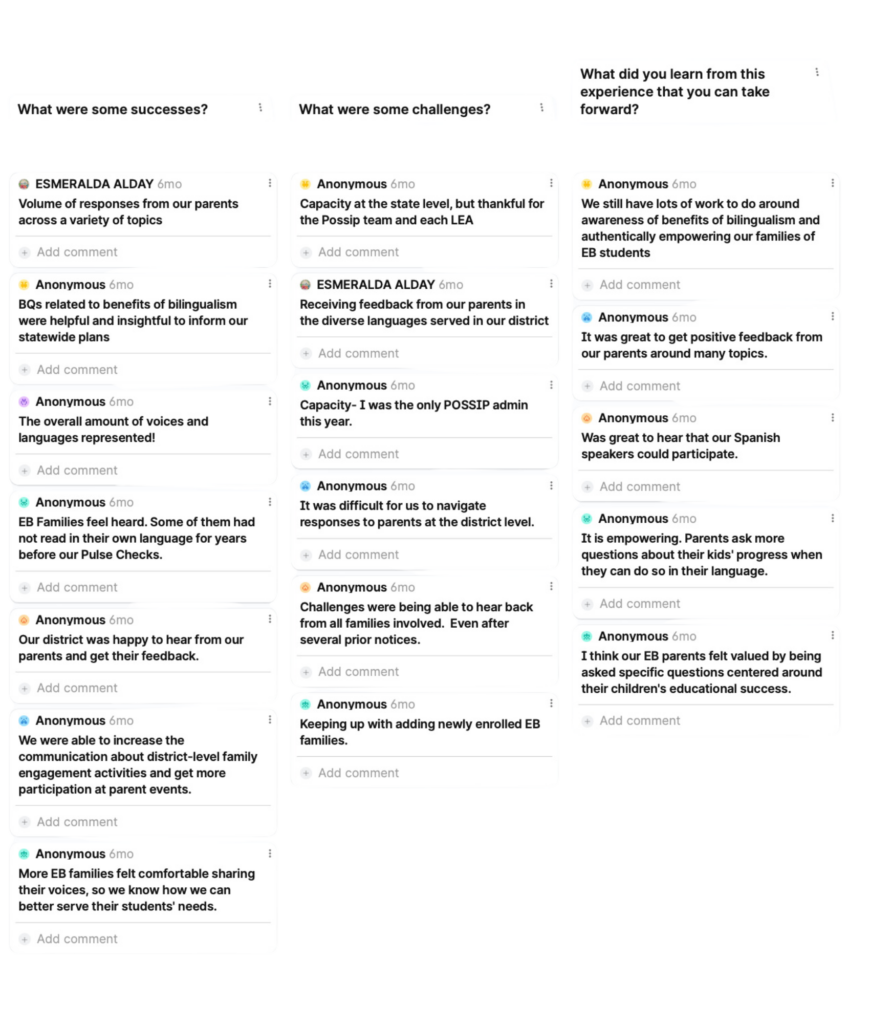
However, with Possip, the district saw a significant increase in engagement, with 32% of families responding and 80% of responses coming in languages other than English.  With over three times as many families sharing their voices, the district has much more confidence that they understand trends and feedback from a far greater number of their constituents. 

Possip enables simple, easy-to-access technology that ensures families can be engaged easily and effectively regardless of their primary language.

Possip greatly enhanced the district’s efforts to engage these families since it allows parents to respond in their native languages. Families saw short and simplified questions in their chosen language, significantly decreasing their ability to engage on a deep level. This ease of use and accessibility increased response rates and more meaningful, specific feedback from families, which had been challenging to obtain with previous methods.

Mara emphasized that the success of Possip in Keller ISD is due to its accessibility, particularly through text messaging, which made it easy for parents to participate and provide feedback. The vast majority of families use cell phones, so they can use a tool that everyone has, without worrying about computers or access to wifi. Having the responses automatically translated through Possip ensures families have a voice and provides the district with valuable insights to improve their services for emergent bilingual students and their families.

The use of Possip also has regulatory benefits that can assist districts and schools.

When deciding if Keller would continue to use Possip, their decision was also influenced by its ability to meet Title III requirements for parent engagement. Title III aims to ensure that English learners (ELs) and immigrant students attain English proficiency and develop high levels of academic achievement in English. The tool was initially introduced to the district through a pilot program by the Texas Education Agency (TEA) focused on improving services for bilingual families. The positive results and the alignment with federal requirements made it a natural choice to continue using Possip, funded through Title III, to ensure ongoing engagement with bilingual families.

Keller ISD sees Possip as a win-win for everyone. Families can easily share feedback, schools can better engage with families, and the district can utilize Title III funding to continue the surveying. 

Conclusion

For further reading on related topics, consider exploring the following resources:

By using Possip, with the ability to translate into dozens of languages, you can better set up multilingual families to be an active part of your school community.

Keller ISD

The post Possip Spotlight: Keller ISD Harnesses the Power of Pulse Checks with Emergent Bilingual Families appeared first on Possip.


Wednesday, 6 November 2024

8 Tips to Boost Response Rates

Table of Contents

Surveys can help schools understand how things are going and what your people need, but it only works if enough people respond. Some challenges might stop you from getting the responses you need, but with the right planning, you can overcome them. The more people you hear from, the better you can guide your organization or school to meet those needs.

Cate Reed, an experienced administrator and Senior VP at Teach For America, shares tips to help boost response rates on Pulse Checks powered by Possip and other surveys.

Why Survey Response Rates Matter

Surveys are a great way to hear from staff, funders, constituents, families, and students and Possip makes it easy. But it can be disappointing if you only hear from a small group. How can you know if the feedback represents everyone? How do you make sure one voice doesn’t overpower others? And how do you avoid hearing from just one group of people?

Making sure most of your people engage in surveys – whether it’s a one-time or annual strategic survey or in at least one in a series of shorter surveys over a period of time – makes the data you collect more valuable.

Key Obstacles to Response Rates​

Surveys are a powerful tool, but getting enough responses is crucial. Here are some common obstacles:

  • If you only send a survey once a year, you may not get much useful feedback.
  • Long surveys take a lot of time and effort, which can overwhelm respondents.
  • Some people may worry about negative consequences for sharing critical feedback.
  • Language barriers or confusing questions can stop people from responding.
  • People may feel like their feedback won’t be heard or acted upon.

Luckily, these obstacles can be addressed with a few simple strategies!

8 Tips to Boost Survey Response Rates

1) Publicize Your Survey

Make surveys a normal part of your community’s life. Let your people know when surveys are coming and how often. Update their contact information to ensure they get the surveys. Talk about surveys in person or through other communication methods. Put up a poster in the hall. Send a heads up through Slack or in a newsletter. If people see surveys as the main way to share quick feedback, they’ll be more likely to respond.

2) Offer Anonymity

Some people may be nervous about giving honest feedback. If they are your staff, reassure them that their responses won’t negatively affect their job. If they are a student, reassure them that their responses won’t affect their grades. If they are a parent, let them know their honest feedback won’t adversely affect their child. If they are a funder or volunteer, let them know their standing or loyalty will not be held in question. Let them know they can submit feedback anonymously.

3) Send Surveys at the Right Time

Timing is everything! Don’t send surveys at busy times, like right before the winter holidays. If you are sending a survey to families at your school, don’t send your survey in the morning during drop-off. Instead, try sending them during pickup or other times when families have a moment to spare. Conversely, sending surveys to staff members first thing in the morning gives them a chance to reflect throughout the day or respond immediately before they get swept into the tasks they need to complete that day. Pro Tip: Don’t wake up college students with a survey request. 

4) Ask Simple, Quick Questions

Keep questions short and easy to answer. For example, instead of asking, “What’s the best way we communicate with you?” ask, “Does the weekly email from the HR team give you enough information? Yes, No, or Somewhat?”

5) Use Social Media

Post reminders on your company, school, or organization’s Instagram or Facebook page when you send out surveys. Use these platforms to share what you learned from the surveys and what actions you’re taking based on the feedback.

6) Offer Incentives

Fun incentives can motivate folks to participate. For example, you could hold “Popsicle Fridays” if you hear from 75% of families or do a lottery for those who respond for lunch with a teammate of the winner’s choice or a local diner gift card.

7) Ask Questions That Apply to Everyone to Increase Response Rates

Keep your questions relevant. For example, consider these scenarios: 

  1. Instead of asking how parents liked the first grade play, ask about events that everyone attended, like a school-wide carnival. 
  2. Instead of asking for feedback on a professional development session that a portion of the company attended, ask for suggestions on future sessions.
  3. Instead of asking program participants if they enjoyed the last program event, ask if they would recommend or invite a friend to the next event.

8) Share Results and Actions

When people see that you are listening and acting on their feedback, they’ll be more likely to respond next time. Share what you heard and what changes are being made based on the feedback. Possip makes this easy by providing customized and editable 360 script that summarize the responses you gather from each Pulse Check. 

The more people you hear from, the better you can meet their needs and guide your staff and community in the right direction. When folks see their feedback making a difference, their trust in you will grow.

Resources

Speed Read of 8 Tips to Boost Survey Response Rates

  • Asking people to use surveys to get a sense of how things are going and what they need can be super helpful, and boosted if you get a good response rate.
  • There are ways to predict what might stop you from getting the responses you need, but you can overcome them with some planning.
  • When you hear from more people, you’ll be more confident you are steering your community in a way that will meet the most number of your people’s needs.

Read below for resources, tips, and the why!

The post 8 Tips to Boost Response Rates appeared first on Possip.

Wednesday, 30 October 2024

Supporting Mental Health: Types of Support

The National Institute of Health study found that a social network of varying supports is an important factor in an individual’s mental health. Social support can influence many aspects of our mental health such as resiliency, self-esteem, decision-making skills, and achieving goals. Support networks can be comprised of Emotional support, Instrumental support, and Information support.

Elizabeth Janca, an experienced school administrator, licensed professional counselor, and Possip Reporter discusses the types of supports and importance of a support network.

Emotional Supports

Emotional supports are individuals who show us love, care, and reassurance. These individuals often show that they are actively listening and empathizing with what we are experiencing. An emotional support makes us feel valued and gives us a sense of belonging. 

Think about the people in your life who you see on a regular basis. Who are some individuals who provide acceptance and support for you? For some people, this is parents, grandparents, and friends.

Consider times where you have turned to the individuals you identified. When were they helpful for you? For some people, social supports are necessary in times of grief, making hard decisions, and during stressful times. In addition to our coping skills, social supports can provide assistance in self-regulation. 

Instrumental Supports

Instrumental supports are the tangible aid, or action, that individuals do to support us. Instrument support includes things such as doing the shopping for a sick friend or helping someone with chores around the house.

Consider the group you thought about for social supports. How do these individuals aid you in accomplishing tasks? Maybe a parent helps you make the first call for your first doctor’s appointment at 18 or a friend helps you clean up your room so you can go to the movies later.

Informational Supports

Informational supports are the advice, guidance, and assistance individuals can give us in problem-solving. Consider who you turn to when you have a question about an assignment, homework, or a job application. Parents, teachers, administration, and counselors can be great sources of informational support as they can share their life experiences. Informational supports can also help inform how we approach cognitive distortions.

The post Supporting Mental Health: Types of Support appeared first on Possip.

Tuesday, 29 October 2024

Supporting Mental Health: Types of Support

Unlock a world of exclusive content and insights for leaders who listen!

Join our community of Possip Members to get ahead of the trends, access free resources, and more!

SIGN UP NOW or sign in below.

The post Supporting Mental Health: Types of Support appeared first on Possip.

Thursday, 24 October 2024

Real Talk: Teaching During Contentious Times

Speed Read (tldr) Real Talk: Teaching During Contentious Times

1. Balancing Education and Parental Concerns: Teachers face challenges in discussing current events due to differing beliefs among parents, who want their children educated yet often prefer to avoid political discussions in the classroom.

2. Benefits of Discussing Current Events: Engaging students in discussions about contentious topics fosters critical thinking, builds empathy, and encourages family conversations, helping students develop skills to navigate complex societal issues.

3. Importance of Community Trust: For teachers to effectively address sensitive topics, they need strong support and trust from parents and the community, creating a safe environment that encourages open dialogue and engagement.

Read below for resources, tips, and the why!

Table of Contents

Every teacher has their mortifying story of a student bringing up something taboo in class. Maybe it was something far too personal related to the student’s parents or a topic typically not discussed in a second-grade classroom. But there are times current events and societal changes can push difficult topics into the classroom. Whether and how teachers and professors talk about current events during contentious times is a complex decision influenced by students, parents, and school administrators.

Danielle Bernstein, a Possip intern majoring in Human and Organization Development and Sociology at Vanderbilt University, revisits insights from school leaders and parents on the complexities of teaching during contentious times in light of today’s political climate.

In 2021, Possip CEO and founder Shani Dowell hosted a webinar with Kimberly Robinson, Kevin Hoffman, and Tontra Love. The webinar focused on teaching during contentious times, particularly during a pandemic and a period of racial injustice. Though it’s been years since the last mask mandate, an upcoming election, foreign conflicts and resulting unrest on college campuses, and persistent discrimination against marginalized communities in the United States have pushed current events to the tips of many students’ tongues. Building off insights shared in the 2021 webinar, consider the following best practices when teaching during a contentious time like now.

Wanting to Educate And Protect Students in Contentious Times

Parents want their children to be educated and engaged with current events, but many parents don’t want political discussions in the classroom. With these competing desires, it can be difficult for parents to balance their child’s education and their personal beliefs. In this clip, Shani, Kevin, and Kimberly discuss this paradox and barriers that prevent parents from engaging with their student’s classroom. 

The Argument for Current Events in the Classroom

As mentioned earlier, the decision to discuss current events in the classroom can be complex. With parents and students holding varying beliefs, conflict can seemingly be avoided if certain topics are avoided too. Shani, Tontra, Kimberly, and Kevin argue that discussing difficult topics can be beneficial despite possible parent backlash.

There are four key reasons to discuss current events instead of banning them.

  • Banning a topic typically backfires

Tontra explained that if you tell a student they can’t talk about something, the first thing they want to do is talk about it! Placing a ban on discussions of current events or contentious topics only encourages those banned discussions. 

  • Help kids and young adults build the muscles to talk about difficult topics

Throughout our lives, we will all have conversations with people we disagree with; we will all have conversations that make us confront our biases and ignorance. Discussing current events in the classroom allows kids to build that muscle and engage in difficult conversations with their peers. As Kevin said, “Kids need to build the muscle of being able to talk about current events and life and politics and race” for the preservation of the country and the world.

  • Discussing current events in contentious times forces students to confront issues they wouldn’t otherwise

Talking about current events, especially those that disproportionately impact communities of color and other marginalized identities, allows kids without those identities to develop empathy and understanding. Kids need to be exposed to various perspectives and backgrounds so they can understand and combat racism, discrimination, and prejudice. 

  • Discussions in the classroom encourage discussions with family members

Shani pointed out that if schools “provide the basis of a conversation then at home I can infuse my values onto it or what we believe or how we make meaning of that.” When current events are brought up in the classroom, they contribute to students asking their parents about their beliefs and perspectives.

The Importance of Community and Parental Trust

For teachers to feel more comfortable bringing up current events in the classroom, parental and community trust and support are vital. Shani and Tontra discuss below the importance of building trust and creating a safe environment for students. 

As Tontra put it, “Even when hard things come up, if you’ve built community and you have trust, families will back you and engage you and be part of conversations even if it’s a conversation they’re not comfortable with.” If teachers decide to bring up current events, especially during contentious times, they must ensure they have the proper community and parental support.  

Teaching during contentious times requires tailored approaches. Every classroom and lecture hall is different; every community is different. Teachers and parents alike must consider the many benefits of bringing up difficult conversations with students, and how to do it right. 

contentious times

The post Real Talk: Teaching During Contentious Times appeared first on Possip.

Tuesday, 22 October 2024

Students Who Advocate: How to Write an Effective Email to a Professor

Speed Read (tldr) of Students Who Advocate: How to Write an Effective Email to a Professor

1. Be Clear and Concise: Start with a relevant subject line that clearly states your request. Keep your email short and to the point, focusing on necessary information and specific questions to minimize the professor’s workload.

2. Professional Greeting and Introduction: Begin with a friendly yet professional greeting, and introduce yourself briefly, including relevant details like your class and major. This helps the professor recall who you are and the context of your email.

3. Polite Closing and Signature: End with a formal goodbye and include a professional email signature with your name, class, and major. This maintains professionalism and provides additional context for the professor.

Read below for resources, tips, and the why!

Table of Contents

Whether you need an extension on that ten-page paper, want to clarify a confusing term, or simply want to express admiration for their work, crafting the perfect email to a professor can feel daunting. Oftentimes, the biggest barrier to reaching out to a professor is simply beginning your email.

Danielle Bernstein, a Possip intern majoring in Human and Organization Development and Sociology at Vanderbilt University, explains the best ways for students to communicate with professors through email.

Below are seven guidelines to get you started on your email-writing journey. Through following these steps, you will have a much higher chance of receiving the response you desire – even if your professor’s email ends with “sent from my iPhone.”

1. Have a concise and relevant email subject line.

This is the first thing your professor will see; make sure it expresses what your main goal is. A helpful tip when it comes to writing your subject line is to include your perspective and what you are asking for. For instance, if you are in the professor’s Psychology 1000 course and you are requesting an extension, some good subject lines are: 

Psychology 1000 Extension Request

Psychology 1000 Student Requesting an Extension

Extension Request for Psychology 1000

2. Include a professional and friendly greeting.

Don’t just dive right into things! Begin your email with a professional greeting. My favorite practice is starting the email off with “hello” or “dear” and including “I hope you had a great weekend!” This maintains professionalism while also starting the email off on a friendly note. Here are more etiquette tips! 

3. Introduce yourself – how does this professor know you?

Even if you think or know that this professor knows who you are, it is best practice to offer a brief introduction. Now, this introduction should not be about where you’re from, your favorite color, how many siblings you have, etc. Rather, it should be about what information is relevant to the professor. If you are reaching out to a professor whose class you are taking, introduce yourself as “a student in your Psychology 1000 class on Mondays and Wednesdays.” If the email is a cold email to the professor asking to participate in their lab, it makes sense to offer a more robust introduction, such as where you’re from, what you’re studying, etc. 

4. Be specific about your needs, and limit the amount of work for your professor.

Professors have a lot going on. They don’t have the time to search for the specific assignment you did not receive a fair grade on. So, be specific about what you’re asking. Provide all the necessary information you have that a professor needs to answer your question or fulfill your request. 

If you’re looking to provide feedback to your professor, follow these guidelines. The article is written for a parent writing to a teacher, but you can follow the same positive, solutions-oriented approach!

5. Include a formal goodbye and an email signature.

End your email on a positive note. Wish your professor a good weekend and that you look forward to hearing back from them soon. To make your email and its ending as professional as possible, add an email signature with your name, class, and what you are studying. This provides further context on who you are and makes your email more professional. 

6. Keep it short and to the point

Have you ever heard that it takes longer to write a shorter essay than it does a longer one? This is because it takes more thought to write concisely. Your email should include only necessary and relevant information. In this case, less is often better. 

Be mindful of how much you are writing and what needs to be included in your correspondence. The length/content of your email will also vary based on your request. If you are hoping to secure a meeting or research position with your professor, it is good practice to describe what specifically interests you. Saying “I find your work interesting” is not as effective as “I find your research on renewable energy systems compelling, especially the development of next-generation solar cells, as I am incredibly passionate about clean energy solutions.”

7. Ensure your email has proper grammar and spelling

Yes, sometimes professors don’t respond with the most grammatically correct emails, but they’ve also been in academia for years and have a lot of student emails to respond to. As a student, having a few glaring spelling or grammar mistakes can make your email seem unprofessional and rushed. Do at least one read-through of your email to ensure it’s concise and absent of any spelling or grammatical errors. 

Here is an example of emails you can send to a professor that follows all seven steps outlined above: 

Subject Line: Sociology 1150 Student Requesting Exam Makeup

Good morning Professor Murray, 

I hope you are having a wonderful start to your week. My name is Danielle, and I am a student in your Sociology 1150 section on Tuesdays and Thursdays. This morning, I developed a fever and have been unwell all day. As a result, I will not be able to take the exam tomorrow at 9:00 AM. Is it possible to find an alternative day to take the exam? 

I appreciate your understanding, and I am happy to provide a doctor’s note if needed. Thank you and I hope you have a great rest of your day. 

All the best, 

Danielle 

Subject Line: Sociology Major Interested in Research Lab Position

Dear Professor Kline, 

I hope you had a great weekend. My name is Danielle, and I am a junior at College studying Sociology and Child Development. I saw your announcement in this month’s newsletter about an opening in your research lab, and I would love to learn more about the position. 

I am incredibly interested in the intersection between neighborhood context and students’ literacy rates. While I have conducted independent research on the subject in the past, I would love to gain a more in-depth understanding through working with you in your lab. 

Please let me know if there is a time this week that works for you to discuss the position. I am free all day Tuesday and Wednesday, but please let me know if another day works best. I look forward to speaking with you soon. Have a great rest of your day!

Sincerely, 

Danielle 

Subject Line: Questions on Econ 1001 Final Exam

Hi Professor Chang, 

I hope you are doing well as the semester comes to a close. My name is Danielle and I am a student in your Economics 1001 course. I have the following content and format questions for the Econ 1001 final exam next Friday. 

  1. What is the exam format – multiple choice, free response, short answer? 
  2. Could you explain the difference between a change in quantity demanded and a change in demand? I’m having trouble understanding how shifts in the demand curve differ from movements along the curve.
  3. How long is the final exam? 

Thank you for answering these questions; I look forward to your response. I hope you have a stress-free end to the semester; thank you for a great course!

Warmly, 

Danielle

Subject Line: Office Hours Request for Sociology 1010

Dear Dr. Mac,  

I hope you are having a great morning. My name is Danielle, and I am a student in your Sociology 1010 course on Wednesday evenings. I have been struggling with recent course material, particularly identifying the distinction between functionalism and conflict theory. Could I schedule a time to meet during your office hours on Monday next week? I am free from 2:00 PM until 4:00 PM. 

Thank you so much. I look forward to meeting with you soon. 

All the best, 

Danielle 

The post Students Who Advocate: How to Write an Effective Email to a Professor appeared first on Possip.

Monday, 21 October 2024

Supporting Mental Health: Tips for Improving Focus

Focusing can be tough. Everything from stress, anxiety, ADHD, age, lack of sleep, and not eating well can impact our ability to focus. Harvard Medical School explores additional factors that may impact focus in adults such as inflammation, medication side effects, and information overload.

Elizabeth Janca, an experienced school administrator, licensed professional counselor, and Possip Reporter discusses techniques to increase focus.

While being able to address lack of focus is important, it may also be helpful to seek counseling or medical support to alleviate additional causes of lack of focus.

Games and Activities for Improving a Child's Focus

A lot of children’s games and activities have a development component. For example, putting a circle into a circle shaped hole promotes matching and gross motor skills. 

So what games and activities promote focus and attention span? Games such as memory, puzzles, and building blocks are helpful. Additionally, timed activities and cooking have been proven to be helpful with older children to continue to develop attention and focus.

Tips on Improving Focus

The post Supporting Mental Health: Tips for Improving Focus appeared first on Possip.