Feedback matters. Join us to learn more about how Possip collects, analyzes, and reports back feedback within your school communities!
The post Possip Live Demo appeared first on Possip | Engagement Platform | School Feedback Survey.
Feedback matters. Join us to learn more about how Possip collects, analyzes, and reports back feedback within your school communities!
The post Possip Live Demo appeared first on Possip | Engagement Platform | School Feedback Survey.
Shani Dowell, Possip CEO and Founder, shares important forms of reflection as the year comes to an end.
When I first started Possip, two big questions stood before me like boulders in a path.
In my mind, hearing from families would help schools and districts be stronger. But the question of whether schools wanted feedback – or whether parents would share – became potential obstacles.
As we close out our 6th year of Possip, I can answer both questions definitively.
Yes.
Instead of boulders in the path, schools wanting feedback – and parents, caregivers, students and staff wanting to share – are accelerants. That doesn’t mean every school wants feedback – or every parent will share. But the power and impact we see from those who do share has become like rocket fuel to what is possible in schools when we ask, listen, and act on feedback.
Seeing the power and impact provides additional reflection points:
Asking for feedback is leaders saying, “I can handle hearing hard things.” “I can be stronger from learning.”
When leaders ask for feedback, they say, “I am shaking free the idea I’m perfect.” “I am asking you about things I may not have the power, skill or capacity to change.”
That things can be better or different. That someone is listening. That the individual can be an agent of change.
They trust that the people, organization or system they are sharing with cares what they think – and can do something about their experience.
So often things happen and while you may understand the order of events, you may not know the impact of the events. I remember in Possip’s first Pulse Check in February of 2017, a parent shared the positive impact a teacher made on her anxiety-ridden child by giving her child a journal and encouraging her child to write. Another parent wrote about the positive impact a parent made when their child was absent and the teacher called to check in on the child. I remember a Pulse Check where a parent shared the impact of a disciplinary decision involving her child.
As the principal read this comment, the principal said “I knew all of the events surrounding this decision but I didn’t realize the impact it had.” So often things happen and move so quickly in a school day – that it is hard to know the impact – positive, negative, or neutral.
Closely connected to the power of impact are the limits of even the best of intentions. We often miss the opportunity to learn more about the success – or failure – of our intentions. In large systems like districts and schools, we make decisions with the best of intentions. No one wakes up and asks how they can make a big decision that negatively impacts tens of thousands of people.
And yet we know that the realities from any policy perspective is that sometimes our decisions have negative and unintended consequences. Unfortunately, without easy ways to hear about the impact of positive intentions, a lot of schools, districts and organizations have to suffer from more painful ways of hearing from their community about the negative impacts of a decision.
I was recently interviewing someone and they said “conflict is a part of life – you just have to go through it.” This resonated with me as a truth. So often what stands in the way of engaging in difficult conversations is the fear of conflict. Conflict really is a part of life. Finding productive ways to engage in, and manage through conflict are important skills.
Gosh. We’ve learned hard in new ways the past 3 years. I was at a fundraising event last year, and the speaker shared a well known quote from the head coach of the Phoenix Suns, “everything you want is on the other side of hard.” In our work we get to walk alongside our partners in the hard. We see parents sharing hard feedback – about kids struggling with mental health, academic needs, feelings of isolation, bullying. We see schools having to deal with the hard – staffing shortages, COVID and sickness protocols, changing policy environments, attendance and enrollment challenges. But we also see them walking forward – towards a future on the other side of hard.
The post Moving into the New Year: 2022 Reflections appeared first on Possip | Engagement Platform | School Feedback Survey.
Possip’s CEO Shani Dowell sat down with mental health counselor Malené Dixon and Catherine Cecere of Joffe Emergency Services to discuss school safety. After the conversation, Possip had requests from attendees to recap the tangible use cases and takeaways.
First, let’s pause there on the statement “keeping schools safe.” Notice, it’s a verb. As a society, we can’t guarantee we will always have safe places, but we can work together at keeping safe places for everyone. We can do this by creating:
Shani Dowell shares starting points for a safe school climate, highlighting in this 1-minute clip a helpful mindset for establishing and adapting systems that can be adapted to unpredictable situations. 1.) Have templates to guide you, but respond appropriately and according to real-time situations. 2.) Ask questions, get answers, and keep listening by using Possip surveys and other methods.
From Shani: We need to be talking about competing ideas. Keep understanding that the answers are not always easy answers, but there are strong systems to put in place. Keep learning and hearing from our students and staff so we know what’s important to them.”
Catherine Cecere shared a visual for this ecosystem below and discusses these “circles of safety.” She points out, “We at Joffe talk with schools about: how do we keep people safe and how do we make them feel safe? As you can imagine these have so much overlap, but they are not always the same thing.” Critical actions: 1.) Keep people physically safe. 2.) Keep people feeling safe. She discusses administration’s role and other critical actions centered around communication practices in the full conversation

Cat made excellent points summarized here and in the 1-minute clip below. 1.) Learn trauma-informed practices. 2.) Make practicing safety intentional and meaningful.
From Cat: We need to talk about meaningful and trauma-informed practices. Keep talking to kids about what could happen and how to keep our bodies safe. Keep talking to parents about how we practice intentionality of decreasing trauma.
In closing, we loved this key takeaway from mental health counselor Malené Dixon. Safety impacts attendance. How safe and secure a student feels at school is a determining factor of whether they show up at school. Malené pointed out that when schools have threats to campus, they likely have the lowest attendance of the year the next day – stating that was true for her former campus KIPP Sunnyside in Houston, Texas. Hear more on how safety impacts attendance in this one-minute clip with Malené and join us for a special conversation on increasing attendance this January.
The post Actions for Keeping Safe Schools appeared first on Possip | Engagement Platform | School Feedback Survey.
Modern day expectations and laws reinforce the message that every kid should be in school every day possible. However, historically that hasn’t always been the case. History tells the tale of kids staying home to offset families lacking resources, zoning and discriminatory regulations. This has required people to attend schools far from their homes, and unsafe and time-consuming transportation to school, not to mention unwelcome environments for many.
It’s not surprising that people need support and motivation to get to school. It’s not surprising that when things get tough (insert: unsafe, unkind, inconvenient), people might not show up or lean into difficult situations.
There are real tangible factors influencing attendance – physical and mental health, transportation, safety and communication – and Possip’s new Attendance Checks help districts and schools uncover which factors have become barriers to individual families. As you may or may not expect, families are still identifying COVID as the top barrier to missing school.
It begs the question: how do districts and schools …
1) more fully understand and address barriers?
2) shift mindsets so that families, kids and teachers agree it is important to show up for school?
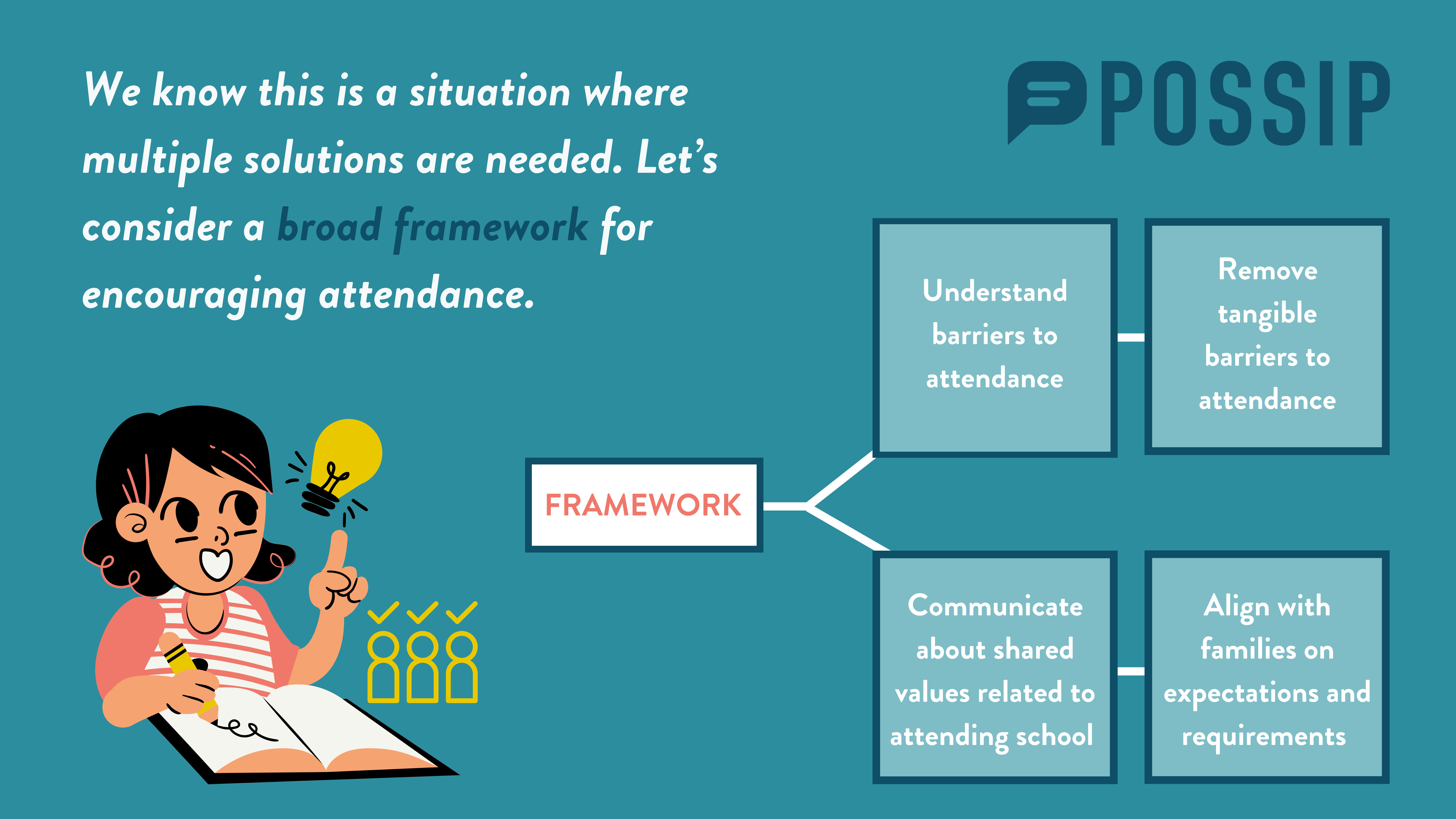
This January 24th, Possip will gather with educators to talk about improving attendance. We know this is a situation where multiple solutions are needed.
A: Understand barriers to attendance
B: Remove tangible barriers to attendance
C: Communicate about shared values related to attending school
D: Align with families on expectations and requirements
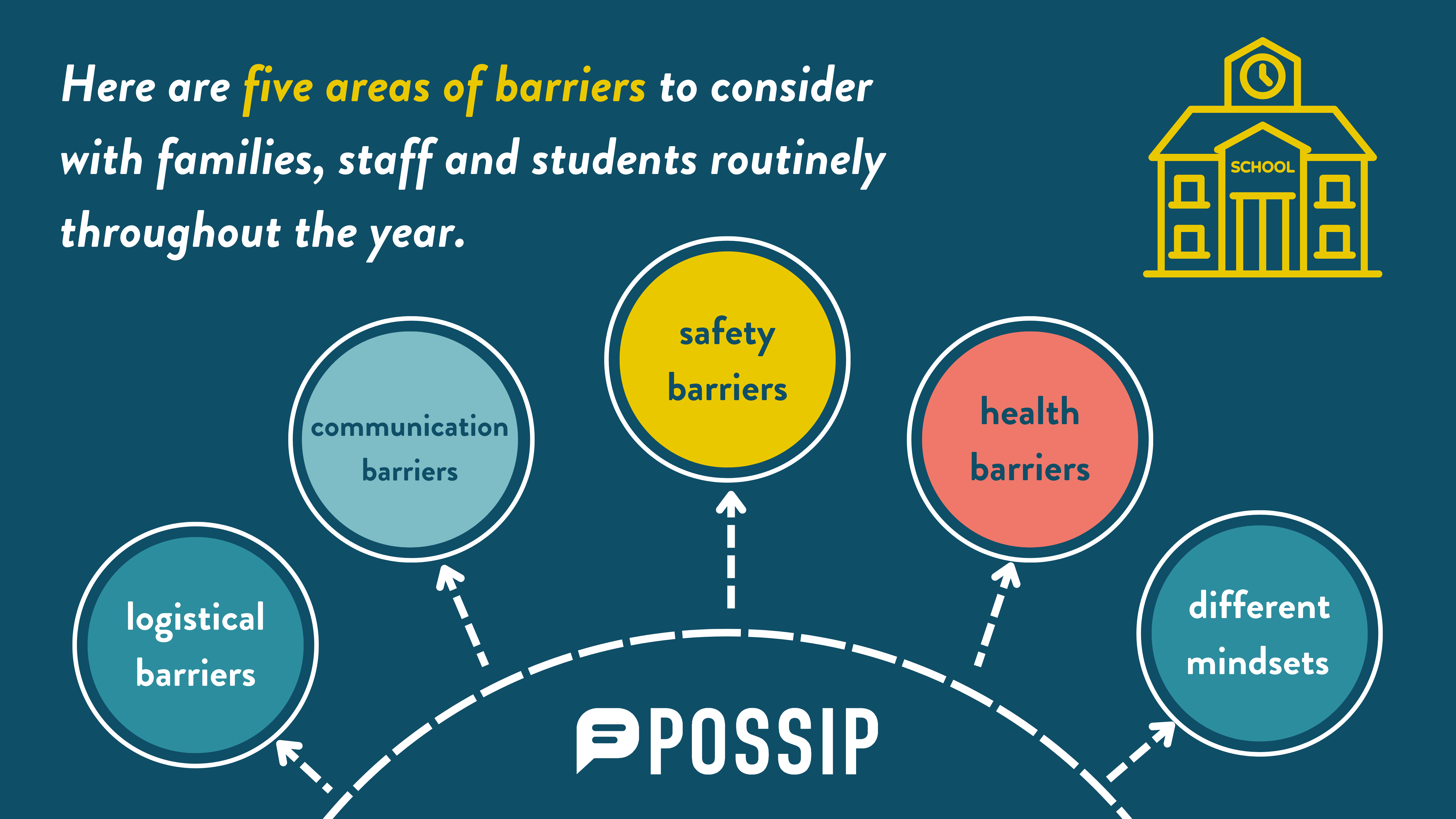
There may be logistical barriers related to a caregiver’s ability to get a student to school such as the ability to afford transportation or help a student get to a bus. Parents may have competing commitments with work or caretaking and are unable to focus on logistics for a school-aged child.
There may be communication barriers that influence whether a parent is fully informed about attendance expectations or able to communicate needing assistance. This could be due to cultural or language differences. It’s possible that families have also received conflicting information or even heard conflicting mindsets toward attendance from their teachers, children or fellow parents.
There may be health barriers that are either physical or mental impacting the student or family members responsible for getting the student to school. There may also be concerns about illnesses spreading in school, or that a school environment is impacting a student’s emotional well-being.
There may be safety barriers. It was illuminating in the November conversation between Possip in educators on school safety when former school counselor Malené Dixon, Senior Counselor & Student Leadership Advisor at KIPP Sunnyside, said, “If students don’t feel safe, they aren’t going to school.” Similarly, if parents don’t feel their students are safe, they aren’t going to send them to school. Addressing school safety – including bullying and disciplinary concerns – will impact how families and staff feel about being present.
Last, there may be different mindsets about the importance and value of attending school. These mindsets may be determined by the families’ level of engagement with teachers and administrators, cultural points of view, or even how students and families feel about their academic progress and the value of time spent in class. In these and other ways, mindsets or belief could become a barrier to attendance.
Then, once you have a practice of uncovering these ever-shifting barriers for each individual family, you can address needs one-by-one in real time.
(Peer educators will talk through their favorite approaches to addressing attendance barriers on January 24th and you are invited – RSVP now to join the conversation!)
Addressing transportation barriers: Possip reporter Virginia Williams gives helpful insights on tackling car line at your school.
Addressing communication barriers: Possip Reporter Savannah Staley shares communication plans and templates (see #7).
Addressing health barriers: The pandemic taught us a lot about establishing and communicating safe health practices in schools.
Addressing safety barriers: Possip CEO & Founder Shani Dowell provides a framework for safe schools and ways to communicate about safety.
Finally, it’s important to emphasize the final two aspects of the framework – communicating the value of attending school and aligning with families, staff and students on expectations and requirements. Aligning, like giving and receiving feedback, is a two-way street. Signing a handbook or statement of intent is not aligning. Alignment is active, personal, and affirming.
Active – First, understand that barriers to attendance may be temporary and changing, or permanent. Use multiple methods and frequent, routine opportunities to talk about how attendance is going. Is it easy? Is it hard? Are these barriers? Use surveys like Possip Attendance Checks, implementation of structured conversations at parent-teacher conferences and in staff meetings, newsletters, teacher letters, and more.
Personal – Second, make attendance a personal matter. While school culture and shared values will greatly impact both attendance and future enrollment – and we have tips on that from Monchiere’ Holmes-Jones, the CEO and Founder of MOJO Marketing + PR – the solutions for addressing barriers need to be considered case-by-case.
Affirming – Last, affirm that families, staff, administration and students are aligned and mindsets are mutually aligned. This can be accomplished through surveys like Possip Attendance Checks and receiving feedback that expectations and requirements are indeed understood, shared and valued.
We look forward to seeing you on January 24th when educators talk more about identifying and addressing attendance barriers and improving attendance!
The post Tips on Maximizing Attendance in Your Schools appeared first on Possip | Engagement Platform | School Feedback Survey.
 November top 10 family trends are in! Similar to patterns from last year, happiness tends to dip as schools approach the end of the calendar year. This has historically happened during the late Fall months!
The post Top 10 Family Trends in November appeared first on Possip | Engagement Platform | School Feedback Survey.
Savannah, a current Possip reporter and former educator, shares tips for teachers returning back to school for the Spring semester!
The days of sleeping in, eating sugary treats, and binge-watching Netflix are almost behind us. Soon, students will be filling the school hallways and classrooms as back-to-school resumes. Going back to school after an elongated break can feel overwhelming, but it doesn’t have to be!
It’s also a wonderful opportunity to reset with your students by revisiting classroom norms, setting aside time for reflection, and helping students with intentional goal setting. Additionally, taking the time to reflect rather than jumping straight into the curriculum will help establish trust with your students. From my own experience, the human-centered, holistic approach yields higher buy-in and motivation from students because they feel invested in.
Here are five tips and ideas for coming back to school this spring semester:
Rather than making New Year’s Resolutions, consider writing New Year’s Reflections with your students. Here is an example I used with my 11th and 12th graders, but this could easily be adapted for younger students as well. My advice is not to assign this as homework, even though it’s tempting to! Instead, take the time out of daily instruction to work on this. This will show students that this really is a priority for you.
Consider completing this worksheet yourself and using it as an exemplar. Encourage, but do not require, students to share out in a safe and community-centered environment where students feel comfortable and heard. Choose one of the prompts, and ask students to record their answers on a notecard or sticky note. Hang these on a bulletin board, or somewhere where students can see them as a means of personal accountability. Spend time revisiting these reflections throughout the remainder of the school year.
While it’s tempting to jump right into curriculum, it’s important to provide space for students, and yourself, to transition back into the school year. If possible, avoid heavy homework loads and spend time revisiting classroom norms and expectations. Transparently share your own goals and hopes with your students and ask them if these goals feel achievable and appropriate. If you are noticing student fatigue throughout the day, provide opportunities for brain breaks and socialization / community building. In the moment, it might feel like you’re “wasting time,” but you’re not! This intentional resetting will greatly pay-off and set the tone for the new year.
Here is an article to provide you steps on how to ease into January!
Help students create academic goals and intentions for themselves. These goals should be measurable and achievable. Encourage students to share their goals with a peer, family member, or teacher to help hold them accountable. Consider making a class goal, or set of goals, as well to promote community building and collaboration.
After spending a significant time away from school, it’s natural for students to want to connect. However, the nature of COVID has also changed this a bit, and has caused students to become more isolated. Teachers are seeing that students are having a difficult time collaborating academically with other students, or even just socializing.
Create structured time for students to connect with one another. Perhaps it’s a restorative circle, or a ten minute weekly class check-in. For a more creative approach, write a handful of age-appropriate and inclusive questions on a ball and ask students to pass the ball around the room. Whatever question the student lands on when they catch it is the question they are encouraged to answer. While providing students time to connect is important, just make sure it’s structured and purposeful so that it will in turn be meaningful.
As a former teacher, I remember how difficult it was to keep up with my own family and student communication goals. Year after year I would tell myself that I would communicate with ten families weekly and hold regular student writing conferences. However, as the school year progressed and I became more overwhelmed and exhausted, this dream rarely lasted for more than a couple of weeks, until I approached it more strategically.
Consider creating a student communication tracker individually or with your grade level team. Ask students to write down their family’s emails, phone numbers, the best time to reach them, the best way to reach them, and home language. Once you have this information, mindfully communicate with families. You might send out a monthly newsletter or family email, then track which families you’ve connected with. Block time out on your calendar so you prioritize this! Revisit and rework your communication goal as needed throughout the semester.

Welcome Back!
Possip’s staff really does hope you’ve enjoyed your winter break and are looking forward to the new semester! Hopefully, these tips spark some excitement as you think about returning back to school for spring semester with your students. Overall, choose mindful practices that will allow your students and yourself an opportunity to slow down and ease into the new year with intention.
The post Back to School Tips for Spring Semester appeared first on Possip | Engagement Platform | School Feedback Survey.
Join a panel of parents and school administrators on Thursday, December 8 as we talk through case studies and solutions to one of the top trending feedback topics.
The post Campus Safety Case Studies appeared first on Possip | Engagement Platform | School Feedback Survey.
